Friday, July 8, 2022

Glitch

So far, our best-laid plans haven’t really gone aglay in a big way. OK, we had a bit of problem with the trains getting to Tenby, and Sattie has occasionally taken us on an eccentric route, but we’ve been able to cope.

I was confident that our flights would be OK, because they’re not supposed to cancel them with less than 24 hours notice, are they? And yet…that’s exactly what BA have done to us. I got an email at quarter to six telling us that the flight was cancelled, would we like to rebook? After holding for half an hour they kindly informed us that there was nothing available until Monday. BASTARDS! We’re rebooked onto that flight at 06:20 (double bastards! I’d booked a much friendlier 13:45 flight originally). I’ve secured a hotel room at Gatwick (no way are we going to try to get to Gatwick at 0420 from anywhere without a car), and will be claiming compensation from BA for this.

BAstard Airways

I’d like to give a big shout out to BA’s call centre staff for being incredibly unhelpful. After spending two minutes trying to locate my details (I’d given him the booking reference), his next question was “How can I help you?” my response? “How do you think you can help me?” Monkeys could do better.

Our trip down here was quite nice, though. We stopped first at Stamford, which is famously picturesque, and boasts more listed buildings per head of population than any other town in the UK. An odd claim, to be sure, but there it is. It also has an inordinate number of churches!


After lunching in a café there, we headed down to St.Albans to visit the Roman Amphitheatre and museum. At the moment you can’t really walk into the amphitheatre, because they’re preparing an open-air production of The Importance Of Being Earnest, so the stage is set up and there’s lighting and wires everywhere. Afterwards, we went to the museum, where we discovered that we should have been offered a discount to visit the two sites. The ticket guy said he couldn’t retro-apply the discount, so he instead sold us two seniors tickets.


The museum has various artefacts from the Roman times and explains the importance of Verulamium. There’s bits about Boudicca as well (she wasn’t a big fan of the Romans). All very  historical and stuff.

The drive to Sussex was largely extremely boring, involving the A1, M1, M25 and M23. We experienced M25 traffic at its finest! I miss it (not!). It was only as we were approaching our lodgings in West Hoathly that a strange feeling of déjà vu overcame us…this is the same place we visited a week or so ago to go to the Priest’s House! We found the location without incident, decamped our stuff, signed into the wifi, and read our emails….


Wednesday, July 6, 2022

Gainsborough Old Hall

Today’s adventure is to Gainsborough Old Hall. This, it will surprise you to learn, is an old hall, in Gainsborough.

We drove out, about an hour away, and located it easily enough. All the street parking surrounding it was taken so we ended up in the car park next to a pet food superstore.


The hall was built in the late 15th century and is an example of a late medieval manor house. It was built by Thomas Burgh, basically to show off how wealthy he was. It’s now another English Heritage property, so cost savings again! Nearly all of the hall is open to the public, and there are various signs and placards around the place, as well as a guide in the kitchen who explained about medieval cooking practices. The chief chef, apparently, stood high above the kitchen in his own gallery, shouting out orders and directions to the kitchen boys below (it was exclusively male staffed) much in the manner of Gordon Ramsay on Masterchef. The spits were turned manually – automation hadn’t happened yet – by spit boys who sat in little alcoves to the side of the fire. Must’ve been hot work! 


The chef's gallery inside the kitchen

We also toured upstairs, which showed how the upper levels had been subdivided. After its ownership by five generations of the Burgh family, it was sold to William Hickman, and stayed with the same family, who moved out in 1720 but retained ownership. The Hickmans had substantially invested in the building over a long period, and added such things as the tower, and encasing much of the structure in brick. Since then it has been used variously as workshops, theatre, hotel, tenements and assembly rooms. In the 20th century it was opened to the public as a visitor attraction, until being taken over by English Heritage.

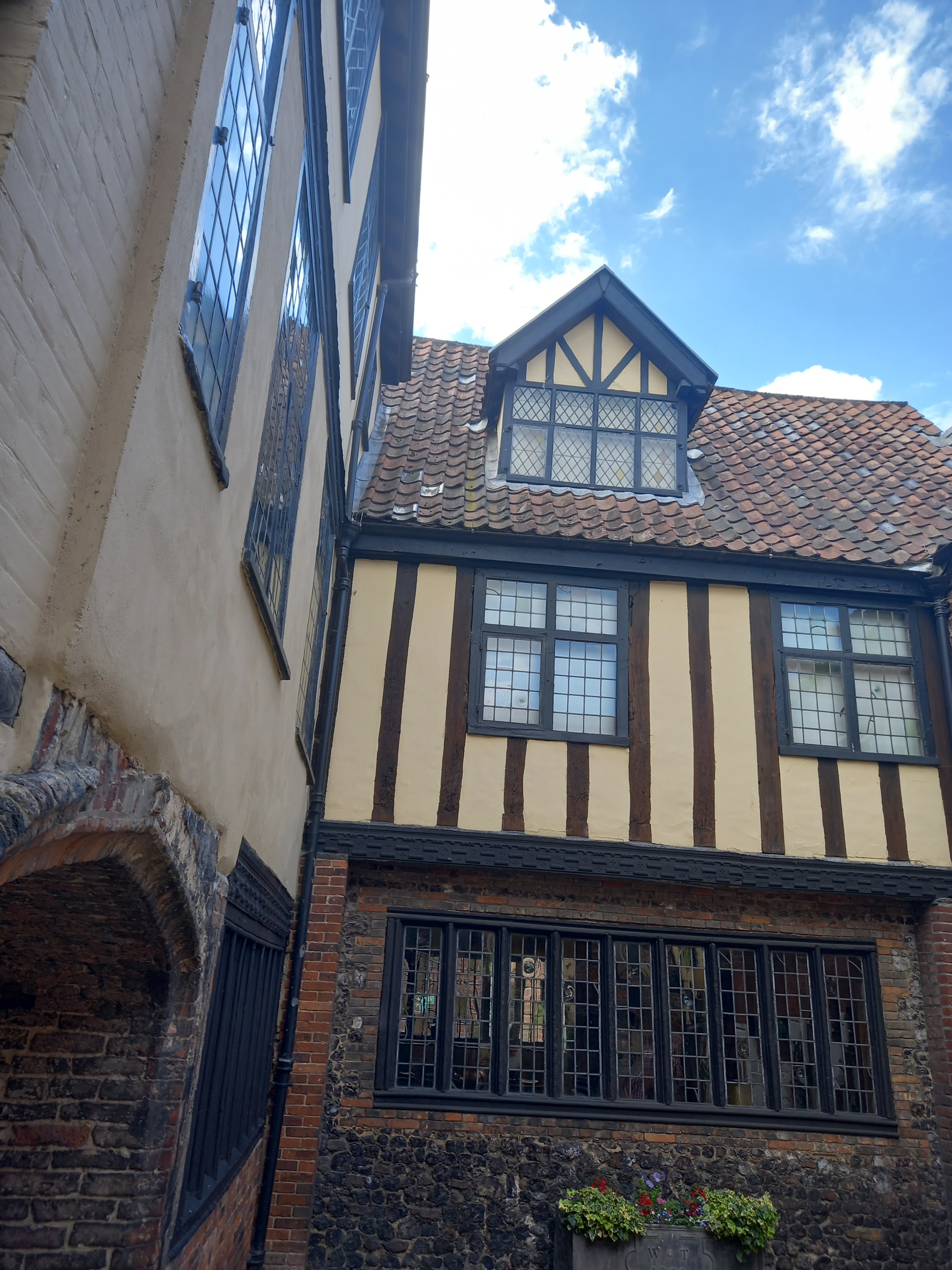
Ye olde hotel room

Afterwards we picnicked in the grounds, then headed back to our digs. A much shorter outing today after yesterday’s marathon Lincoln day out.


Tuesday, July 5, 2022

Lincoln

We drove into Lincoln to visit the castle and cathedral. Nicola particularly wanted to do it today because, while evensong is held every day a 17:30, she particularly liked the programme for Monday.

We parked in the central car park and walked through the city centre. Most of this is now given over to the usual retail suspects, but elements of the old town still persist. 


To get to the castle and cathedral you have to walk up a steep hill called Steep Hill. Imaginative bunch, medieval town planners! It’s very old and picturesque, so we stopped often to take pictures, and not to catch our breath, oh no, no, no, not at all!

Actually one of the less steep sections

The castle was built by William The Conqueror in 1068, as part of his conquering. Wherever he went, he built a castle, with the aim being that his men could ride between them at any time in less than a day, thus saving them from being caught out in the open. He didn’t have that many men when he first arrived, and England was still very much not-properly-conquered, so his army had to subdue numerous rebellions and uprisings around the country. He built around 500 in total, many of which are still around today.

Actually, the law courts

The castle is built on a hill (unusual in Lincolnshire), the site of an old Roman fort, which gives long views in all directions – always a key consideration when locating your castle. Lincoln was a major city at the time, part of the Danelaw. The castle was originally built of wood, later of stone, and is unusual in that it has two mottes, the first named Lucy’s Tower after Lucy of Bolingbroke, sherriff of Lincoln in the 12th century. We learned all about the history and personalities associated with the castle from our guided walk, which was more of a “walk 100 yards, stop and listen for 10 minutes” than an actual walk. Our guide Marion took us to half a dozen locations and explained their history and significance.


There's a dragon in the wall

By the time we’d finished, we decided to take a break for lunch, and found Café Zoot round the corner. Duly refreshed, we went back to the castle to do the walk around the castle wall, then into the Victorian prison to view the original Magna Carta and Charter of the Forest, two important documents in England’s history. Whilst Magna Carta is well-known, the Charter of the Forests actually affected ordinary people far more, as it returned to common use  huge swathes of land. Around ⅔ of all land in England had been seized by Kings Richard III and John as hunting grounds, and it was illegal for anyone else to hunt, or plant crops, there. People were starving. As part of his efforts to ensure that John’s successor, Henry III, would be seen as good king, the regent William Marshal convinced Henry to re-sign it. It had been originally signed under John, but he had it annulled by the pope three months later.

The castle had its ups and downs, fell into desuetude, but was revived in the 18th century when a prison was built there. The castle had always held prisoners and had been a centre for the courts – indeed, the modern-day crown court is inside the castle walls – but this was a purpose-built, three-story building which followed the new regime of isolation, i.e. prisoners had very little contact with each other, which could lead to bad habits, but were kept isolated in order to reflect on their crimes. This isolation extended to the prison chapel, where each prisoner was in a separate cubicle looking forward, and could not see of communicate with others. This chapel is the last surviving one of this type.


 OK, that’s enough castles. After a quick tea-break, we crossed over the road to the cathedral, and toured that. They have many splendid things there, including two huge rose windows, the Dean’s Eye and the Bishop’s Eye. It also has an imp. Amongst its famous inhabitants are the viscera of Eleanor of Castile. Medieval embalming involved evisceration – the tomb in Westminster palace is exactly the same as the one in Lincoln cathedral. They were a weird lot, those medievals. Also, the tomb of Little Hugh can be found here.


 Whilst Nicola attended evensong at the cathedral, I headed back down Steep Hill, stopping in at Steep Hill Wines and Marks & Spencer for some essentials, then drove the car up to a convenient car park to pick Nicola up from the cathedral. This was harder than it sounds, as the road that Sattie wanted to take me down was closed, so I had to circle around whilst she recalculated directions. Made it there eventually though, and sat in the Magna Carta pub until she arrived.

By the time we got home it was early evening so we decided to go the local pub for dinner.


Monday, July 4, 2022

Castle And Hall

We left Norwich, heading north to Lincolnshire, with a couple of stops planned along the way. The first of these was Castle Rising, near King’s Lynn. This is an old Norman castle, original built by William d’Aubigny in 1138, and gained fame as the place of Queen Isabella, the she-wolf of France. It has been owned and passed down by various families, including the Duchy of Cornwall and the Duke of Norfolk, before falling derelict for a while, being home to a lone lunatic (about whom I could find nothing on t'internet, but it was mentioned on one of the information panels), and finally restored in the 19th century. The castle has never really featured as a military installation and was mostly used as a hunting lodge for the nearby deer park. The keep is now a ruin, but a very picturesque one, and we were able to ascend two storeys high via a spiral staircase, and see some of the rooms upstairs.


Our next stop was Oxburgh Hall, which is a stately home also near King’s Lynn – paradoxically closer to Norwich than Rising Castle, but the house doesn’t open until 11:00 so we decided to do them in reverse order. By the time we got there it was past noon so we got ourselves a cup of tea from the café and had our sammies in the open air, before going into the house to see all the things.

Built in the 15th century for Sir Edmund Bedingfield, it is a moated house in the late medieval style. Four of the rooms are open to the public, so we toured those, talking to the guides along the way, and learning about Dutch embossed wallpaper and other such things. The Bedingfields were left-footers, so they were persecuted a bit under Elizabeth I, but they seemed to have survived it and then supported the Jacobean cause of the Young Pretender. There are many artefacts, paintings and tapestries on display, some fabulous wood carvings, and it’s all generally agreeable. Outside, the moat is covered in algae, which somewhat interfered with my attempts to take a reflection picture. Ah well.


Pictures of old dead dudes, and dudesses

 We had a two-hour drive to our digs in Lincolnshire, so we decided not to hang around any further and get on the road. The drive through Lincolnshire involves a lot of leafy lanes, as Linconshire is (a) one of the largest counties in England, and (b) has no motorways. We made our now-traditional stop-off at a supermarket (which we had to hurry to, as they close at 4 on Sundays! How quaint!) to re-victual, then did the final miles to our cottage, lent to us by a friend of Heide’s. We had a little difficulty locating it at first, as Heide had given us a slightly incorrect house number, but we found it eventually, and even found Hollywood parking right in front of the house. It’s lovely, a far cry from our previous digs, which were in the coal cellar of an old Victorian terrace in Norwich. Converted to a studio, I hasten to add!

We’re settled in here now and looking forward to exploring Lincolnshire over the next few days. 


Sunday, July 3, 2022

Blickling

Today did not go according to plan. Our best-laid plan was to go to Blickling, then on to Blakeney, and Cromer.

I looked up directions to Blickling on Sattie and was informed that it opened at 10:00. Yeah, well, fuck you very much, Google, that’s when the gardens open, we found out on arrival. The house doesn’t open until 12:00. We’d already bought tickets by this stage, so we hatched a cunning plan to go straight to Blakeney and book a seal-watching boat trip from there.

When we got there, a little after 11:00, we found that due to the tide, all the seal-watching boats had left at 10:45. Bugger. By the time we discovered this we’d also dropped £6 for all-day parking (the only option). We walked around the paths a little, but there was a persistent wind coming in off the sea, and very little bird life to be seen other than the ubiquitous ducks and gulls. We did spot what I thought was a blackcap (not a BLACKCAP, which is an entirely different beast) but too far to get a decent pic of it. Blakeney is designated an Area of Outstanding Natural Beauty, apparently, but as the tide had gone out, I designated it an Area of Outstanding Natural Muddiness.


We drove on to Cromer, where fortunately we managed to snag a parking space on the street, and had a look at the church there. Other than that, Cromer offers little in the way of history. We walked back along the coast and returned to the car.


By this time, we were getting peckish, so we headed back to Blickling and had our sammies in the garden there. They also wanted to charge us for all-day parking, but I noted that both Blakeney and Blickling were National Trust properties, and their parking tickets look identical. As I already had a ticket with NT and today’s date on it, I decided to chance it and not pay for another.

Blickling Hall is, in fact, very impressive. It was extensively rebuilt in the 17th century by Sir Henry Hobart, who took over the house previously owned by the Boleyn family, and Anne Boleyn had been born there. It was later remodelled by more Hobarts, and then Kerrs through the distaff side. Amongst other things, an entire staircase was moved from the original entrance hall to another, more impressive area, and extended further. In those days, the size of your staircase was a willy-waving contest. We toured the rest of the house, including the kitchens, and elicited much information from the guides dotted around the house. 


Afterwards, we had a look around the gardens, which were populated by a large flock of greylag geese. It also contained the world’s worst maze.

Worst. Maze. Ever.

By this stage we’d seen enough so, apart from a quick stop for a cup of tea, we made it back to Norwich. This is our last night here – tomorrow we’re off to Lincolnshire.


Saturday, July 2, 2022

Norwich

Today we decided to visit historical Norwich, which has a cathedral, castle, and various historical buildings and other areas dotted around. We’re within walking distance of the city centre, but Sattie decided to take us on a long, rambling route, which did take us along the river Wensum as far as possible, which was picturesque.

A historical wall

First up was the cathedral, which has a very tall spire which you may be familiar with on the logo for Aviva (formerly Norwich Union). We toured the inside of the cathedral, which has many interesting features, including the Edith Cavell grave. The architecture is splendid, with high vaulted ceilings and stained glass galore. There is also a carving of Thomas Gooding’s skeleton with a warning: 


All you that do this place pass bye,

Remember death for you shall dye,

As you are now then so was I,

And as I am so shall you be, 

Thomas Gooding here do stay,

Wayting for God's judgement day

A secret staircase...

...leading to the Cup Room

In the cloisters, a local school was rehearsing their open-air production of Macbeth. They were all wearing battledress and toting machine guns, so I’m guessing they’re doing one of those “updated” versions. There were notices around the place showing how the Norfolk constabulary had licensed them to use toy guns, so the public wouldn’t be alarmed. We stopped for a cup of tea in the café, then headed round the corner to have a look at the castle before lunch.

The castle is currently undergoing renovations. We ascended to the temporary entrance, there to be greeted by an employee who told us we could go in and see the art gallery, but all the medieval stuff wasn’t currently available. This was disappointing, so we headed back down and started to look for the Museum of Norwich, which the castle guide had recommended instead. Along the way we were distracted by the art nouveau frontage of the Royal Arcade, and went to have a closer look. On examination, we found it included a café called Marmalades, and decided to have lunch there. 


We carried on and managed to find the museum, which had hidden its entrance around two corners, and learned all about the history of Norwich, mostly from the Middle Ages onwards and concentrating on the industrial heritage of the town – it used to be England’s second city, and a major producer and exporter of worsted wool, and later fashions and shoes. Nowadays it’s less based on manufacturing, but is still a major centre for insurance.

Buoyed by this success, we decided to try another historic place, Hungate Medieval Art. Despite having a sign outside which assured us they were open Thursday to Saturday, 10:00 to 16:00, it was very firmly locked up and closed. Bah!

Never mind… we continued on to the Strangers’ Hall. “Strangers” was an epithet applied to Dutch and Belgian immigrants who moved to Norwich, escaping religious persecution and also helping to revive the textile industry, which had been severely blighted after fires in the 16th century. Unfortunately, it was closed, because it’s not “high season” yet. Apparently summer doesn’t begin until 27th July in Norwich. 

Strangers' Hall

That’s a 40% strike rate, with three out of five places closed. Ho hum. Tomorrow, we’ll be out of town again, looking north to Blickling Hall and North coast of Norfolk. Wish us luck!


Friday, July 1, 2022

Burgh Roman Fort

We arrived in Norwich and checked out our new accommodation. Unfortunately it’s not quite as luxurious as our previous two AirBnBs. It appears that our host is fairly new to the game, and has only provided us with minimal equipment, particularly in the kitchen. Also, we had some issues with the TV, and at the moment can only watch iPlayer and Netflix. All of this has been communicated to the host, and she turned up yesterday morning with some additional pillows, a toaster, and other items.

Once we were sorted out we headed out to the coast, to find Burgh Roman Fort. This is a ruin, but the walls are still standing out in the open. Originally a coastal fort, the Norfolk coastline has changed so it is now found in marshland away from the shore. We parked up in the car park, then got into a virtual argument with the app they use for parking. Because my credit card is New Zealand, it has a billing address with a four-digit post code. The parochial app designers insist that a post code has a minimum of five characters, so wouldn’t accept my card. I left them a 1-star review, explained their incompetence, and deleted the app. Fortunately we found a machine that would accept old-fashioned card payments, so we did that. 

The East Gate...was here

Walls!

There are various signs around to tell of the history of the site, but other than that it’s out in the open air and you can walk around the walls. It was once garrisoned by equites stablesiana, a Roman cavalry unit. The rest of the area is a nature reserve, and we were on the look out for wildlife. We saw some reed warblers, but otherwise it was common birds. Still, it’s an interesting place.

We stopped for lunch at the Queen’s Head, then decided to head to Wroxham, capital of the Norfolk Broads, and walked along the river. There were swans and geese on the river, and a heron on the bow of a boat. As we walked along, a gentle rain began to fall. This quickly developed into something less than gentle, and so we initially took cover under the tree, then decided to abandon our plan to find a café and instead ran across the car park to get into the dry car. We headed home to find that Norwich was completely dry! It was still quite early and the risk of showers decreased, so Nicola went on a walk to find her grandma’s old house in Norwich.


Norfolk Broads