Thursday, August 4, 2022

Lanercost Priory

To take a break from the Romans, if only for one day, today we went to look at old churches instead. The Priory at Lanercost is now mostly a ruin, with only one part, the nave, being roofed, and used as the present-day parish church of Mary Magdalene.

The priory was founded in the 12th century by a gift from Robert De Vaux. Large parts of it were built from stone scavenged from Hadrian’s Wall. It was visited three times by Edward I on his trips to Scotland (to hammer them), the final visit being prolonged for several months due to the king’s ill health. This is in fact caused the court to move to Lanercost for the duration, making it the de facto capital of England for six months.

After Edward’s death, Robert the Bruce visited for three days, imprisoning the canons and “committing infinite evils”. Being in border country, the priory was always in the wars, and its fortunes fluctuated depending on who was in the ascendancy. It was finally dissolved by Henry VIII along with all the other monasteries. What remains today is the ruin and the parish church. The ruin is under the protection of English Heritage.


The Undercroft


 After a cup of tea and a cake in the nearby tea rooms, we drove on to Brampton. This turns out to be a substantial town, with more shops than Longtown. We were looking for St Martin's Church, which has stained glass windows by Edward Burne-Jones, noted Pre-Raphaelite. We found them:


Back to the Romans tomorrow.


Wednesday, August 3, 2022

Housesteads & Vindolanda

It was a bit rainy and blustery this morning, but we set out anyway to have a look at a couple more of the Roman sites along Hadrian’s Wall. First up was Housesteads, known by the Romans as Vercovicium, or “the village on the slope”. Housesteads is the name of the farm on which the site sat in the 17th century. It was bought up by John Clayton (remember him?) in 1838, and is now owned by the National Trust, but administered by English Heritage.

This is the most complete fort on the wall, and boasts, amongst other things, one of the best-preserved Roman toilets in Britain. We looked through the museum and watched a short film about the place, then walked the longish walk to the ruins themselves. There, you can see how the fort attached to the wall itself, and how the barracks were laid out. Romans built their forts to roughly the same plan all along the wall and elsewhere, only adapting them slightly as local topography required. In Vercovicium, for example, the Commander’s house is on a slope so needed to be changed a bit.

We had a long chat with one of the guides there about the surrounding countryside, whether it was forested or not, and how both the Romans and the local tribes (the Brigantes) used the wood in different ways.

The actual wall of Hadrian

 
The famous toilets


Our next stop was at Vindolanda. A tour was about to leave in 10 minutes when we arrived, and we were told this would take about ¾ hour. In the end it turned out to be twice that length. Vindolanda (“white fields”) is a huge, ongoing archaeological dig site, and another fort on the wall. Roman forts were generally built about 13 miles apart, as this was the distance an infantryman in full kit was expected to be able to walk in a day. That full kit would have weighed around 45-50kg. 

A Roman pizza oven used by the soldiery


The guide was very informative, not just about the site, but also about Roman life. The forts are not true forts, but garrisons for the soldiers. The Roman army was an offensive force, they weren’t concerned with building defensive structures. This is why Vindolanda isn’t on top of a hill, and also why they tried to stick to the same plan as far as possible, so that the soldiers would find it familiar no matter where they were posted. Most of the Romans at Vindolanda where from Northern Europe (France, Belgium, Netherlands) with some from Spain. At this time in the Roman Empire, only about 10% of Romans were actually Italian – it was more a “member of the Roman Empire” than an actual ethnicity. It was normal for the Romans to recruit non-Romans as auxiliaries, and send them off to far parts of the Empire to be stationed away from their home. Most would never return. This is how the Romans assimilated new peoples and tribes into the empire – within three generations, they would be fully Romanised. 

Archaeologists doing their thing

One of the challenges faced by the archaeologists here (and elsewhere) is how far down to dig. There are several layers of forts on the site, the older ones made of wood and the topmost made of stone. Due to the unique topography of the site, there is a very high water table and a number of springs which served the fort. This has preserved a lot of older organic material, which would normally have rotted away. This includes two crucial discoveries: a large collection of shoes and footwear, and other items like boxing gloves, made from leather; and the Vindolanda Tablets, a series of hand-written tablets, with military documents and personal messages from the garrison. There are over 700 of them, and more continue to be found. Most of them are held by the British Museum, although some are on loan back to the Vindolanda Trust for display at the site.

The Shoe Room

As the tour had overrun somewhat, we were starving by the time it finished. Fortunately we were close to the cafĂ©, and we hightailed it there, beating the crowd (there were 30+ people on the tour) to secure our lunch. By the time we’d finished it was about time to start thinking about heading home, via a supermarket to collect some essential supplies.Tomorrow: more Romans!

Tuesday, August 2, 2022

Corbridge & Chesters

We’re in Hadrian’s Wall country. We set out early to explore a couple of sites near and on the wall, en route to our next AirBnB cottage in Longtown.

The first place to stop was Corbridge, or Coria as the Romans used to call it. This is not actually on the wall, but is an important town in the development of the Northern reaches of the Roman Empire, sitting on the crossroads between Dere Street, which ran north from York into Scotland, and Stanegate, which ran across the country from Carlisle to Newcastle. The river Tyne crossing, called Corstopitum, was heavily guarded, initially by a fort containing Roman soldiers. It eventually developed into a substantial town, as the locals realised the benefits of trading and intermingling with the Romans. It became the northernmost town of the Roman Empire. 

The Corbridge Lion, eating a goat


Stop me if you’ve heard this one before…after the Romans left, the locals used the stones from the buildings, then forgot about it and it became overgrown, and then buried, and used as farmland. In the early part of the 20th century, an archaeological dig found the remains of the old Roman town, along with some important finds such as the Corbridge Hoard – a collection of armour and weaponry, buried either for collection at a later date, or possibly to hide it from invading barbarians from the north. The importance of the find relates to some of the organic material found at the site – material which has usually rotted away completely in such hoards – which gave clues as to how the armour fitted together. Other finds at the site include the Corbridge Lion, thought to be a gravestone decoration, and the Corbridge Lanx, a solid silver plate which is now held in the Briitish Museum (a replica is displayed in Corbridge’s museum).

The size of the dig is deceptive: only about 10% of the total town has been excavated, the rest is hidden under rolling farmland. This was a substantial place!

Next, we headed up to Hadrian’s Wall proper. There are a huge number of sites of various degrees of interest and preservation along Hadrian’s Wall, and we’re not going to get to all of them. We went to Chesters fort, or Cilurnum, about 8 miles up the road. There is again a museum, with lots of bits of stone in it: 

The stone room

Water nymphs detail

Early dick pic

Romans were obsessed with their dicks

The site was excavated in the early 19th century by the landowner, John Clayton. He was also instrumental in digging other sites along Hadrian’s Wall, and is credited with saving huge chunks of it for posterity. This site contains the commanding officer’s house, the barracks for the soldiery (from Spain, apparently – there was a lot of mobility in the Roman empire), and the best-preserved baths in Britain (the ones at Bath were actually rebuilt by the Victorians, and aren’t original).


Entrance to the baths

We stayed for lunch, then followed the route of the wall as we drove to Longtown, passing many hikers along the way. Both of these sites are now administered by English Heritage, as are many of the other places in this area. We’ll be backtracking and visiting some more sites that we passed, over the next couple of days.


Monday, August 1, 2022

Belsay

We drove out on Sunday morning to see Belsay Hall, Castle and Gardens. This is a Regency country home, considered the first to be built in the Greek Revival style. It was built to replace the nearby castle. Today, both castle and hall are just shadows of their former selves, with the castle open to the elements. The hall is a shell, and had been left to fall into neglect by the Middleton family. Only necessary repairs to keep the structure weathertight and upright were undertaken.

This has now all changed. A major reconstruction project is going on, which means that the entire hall is covered in scaffolding, which does not make for an edifying spectacle. The rooms are also empty and crucial features covered up whilst they complete the restoration. A few placards dotted around contain a bare minimum of information about the rooms. The ionic and doric columns, the principal feature of the house, are covered up.

It's covered in scaffolding!
There's not much in the rooms

They have a carriage

The tour of the house did not detain us for long. We were offered a "scaffolding tour", but decided not to wait around for that - the next one wasn't until 1230. 

However, one of the interesting features about the place is that it was built from local sandstone…and by “local”, they mean “within the grounds”. A large part of the grounds is now the Quarry Garden, which is a garden set in deep ravines and tunnels from where the rock was quarried on-site. This provides a micro-climate that allows exotic plants to grow in an area where normally they would not survive. This is the kind of thing that was very popular with 19 century types. At the end of the walk, we reached the ruined castle, which is also very picturesque. It's not on the scale of Alnwick and Bamburgh that we've visited recently, but even so, it must have been very impressive when it was a residence. 

The castle

The quarry

Afterwards we stopped at the café and lunched on a local delicacy, known as stotties. Basically a bread roll, but one that bounces, apparently. Ours had sausage and onion jam.

That’s it for the North East, tomorrow we Go West.


Sunday, July 31, 2022

Lindisfarne

Lindisfarne Holy Island is accessible by causeway only at low tide, so we had to make a prompt start to ensure that we weren’t trapped on the island. It’s a bit of a drive from Jarrow – we’d passed it on our way down from Edinburgh, but we made it there around ten-ish. We did the visitor information centre and Priory museum before heading into the ruins of the priory proper, so we knew exactly what we were looking at and who all the main people were. It's an English Heritage site, too, so yay! Savings! Some of them overlap with the historical personages we’ve met elsewhere on our travels around England. The original priory was where St Aidan first founded a monastery in 634, and used as the base for converting the north of England to Christianity, firstly by himself, then by St. Cuthbert who followed in his footsteps. They also wrote (or rather, copied) the Lindisfarne Gospels, written on calf vellum and illuminated, possibly by a team of monks. The main guy seems to have a chap called Eadfrith. The monastery lasted until the Dissolution of the Monasteries under Henry VIII, and the ruins now there date from that time. 


After checking out the menus at two pubs, we settled on a sandwich at a mobile kitchen. We took a brief tour of the gift shops and tasted some meads, but nothing really took our interest sufficiently to part with any cash. We then headed south to see Bamburgh Castle. This had been the stronghold of the early kings of Northumbria. Later, during the War of the Roses, it became the first castle to be defeated using that new-fangled weapon, gunpowder, in the form of cannonfire.

As we approached the castle from the carpark, we were settled on by clouds of insects. Fortunately they don’t seem to be the biting kind, but they are annoying. Inside, we toured around the castle, including some of the state rooms that are open to the public, and we were able to take pictures indoors this time. The castle has been owned by the Armstrong family since the end of the 19th century, who have extensively restored it, and use it to live in for part of the year. The castle has also been used many times as a film set, including for the Netflix series The Last Kingdom.

Roomsful of trinkets

It's very castle-y


We had a cup of tea and a cake at the cafĂ©, then made our way back to Jarrow, again taking a route through the Tyne tunnel. We have one more full day in the North East, then we head along Hadrian’s Wall (roughly) to explore from the other side of the country.

Saturday, July 30, 2022

You Can Run…

…But you can’t hide. Not strictly, true, you can run, but you can’t hide your legs (one million internets to anyone who gets this reference*).

Avid readers of this blog (I continue to believe in these mythical creatures) will have noticed that I haven’t posted for a couple of days. This is mostly because we haven’t done much. And the reason we haven’t done much is that The Covids (official spelling if you’re over 50) may have finally caught up with us. We’re not dead, we’re resting (easier reference for you there). Actually we don’t know for sure, or if it’s or just a cold, but the circumstantial evidence is, if not overwhelming (neither of us have lost senses of smell or taste), at least in favour of it.

 We arrived at Edinburgh Airport on Wednesday, and were given a much more sensible car by Alamo Rent-A-Car – a Hyundai Tucson. We drove south, feeling increasingly worse for wear. Nevertheless, we stopped off according to plan at Alnwick Castle, seat of the Lords, then Earls, then Dukes of Northumberland, aka the Percys. As dukes, they’re a bit of a johnny-come-lately, only having had the first dukedom in 1766. The castle is very castle-y, and was used as a set for some parts of the Potter franchise. This is unfortunate, as they do seem to base an awful lot of their content, and half of the shop, around this. We’d got there quite late in the day, having stopped at a random pub en route for lunch, and were advised to visit the state rooms first, as last entry to those is at 4:00pm. Unfortunately we’re not allowed to take pictures of the interior (and there’s a sharp-eyed guide in each room to enforce this), but it was all very beautiful, and is still used in the winter as the family’s residence. There was also archery practice in the castle, but again last bow-off (technical term) was at 4:00pm, so we missed that. After touring the outside wall, we checked out the Duke’s carriage, and then completed the final leg of our journey to Jarrow, inevitably via Waitrose.

Alnwick Castle


The carriage

The following day we didn’t feel much like going out anywhere. A quick trip to Morrisons to get some much-needed drugs was about it.

On Friday, after a day’s rest, we felt slightly more human, so decided to head to Arbeia, South Shields Roman Fort. This site is the remains of the Roman fort built at the mouth of the River Tyne (the local topography has changed a little since then, but it’s still on the Tyne). The fort supplied the garrisons on Hadrian’s Wall, but was not part of the wall itself – that ends on the other side of the river. As seems to be the case with many of the Roman sites we’ve visited, it was firstly burned to the ground, plundered for stone, and then buried and forgotten. In the 19th century it was rediscovered when the land was being developed for housing, and part of it was left as a public amenity. In the 1970s the housing which had been built on the rest of the site was demolished, and the whole place opened up and further excavations made. At the same time, some bits were reconstructed – the West Gate, Commander’s House and barracks. The name derives from the fact that it was garrisoned by a squadron of boatmen from Mesopotamia, and means “fort of the Arab troops”. After being used as a granary in its original formation, it was later used by emperor Septimius Severus as the base for his invasion of Scotland

Reconstructed West Gate

The Commander's Bedroom

The reconstruction has been painted to look like how it would have been in Roman times

The site is still surrounded by housing on all sides, which is a bit bizarre. I wondered where Sattie was taking us when we were driving there, as we were going along urban terraced streets, then suddenly, there's Roman ruins in the middle of the street.

On the way home, Sattie tried to get us lost by sending us the wrong way down a street on a non-existent roundabout, but we eventually found an alternate route and Sattie found where we were. But she was in the huff for the rest of the journey.


* Here's the answer: 


Wednesday, July 27, 2022

Prague

The drive to Prague takes around four hours, so we set off around 8:00am, and arrived almost bang on noon, with a pit stop on the way. We’re staying at the Hilton, but this one seems to have its act together and, so far, all has gone according to plan.

It’s just as hot here in Prague, but fortunately the Hilton is air-conditioned throughout (unlike Le Meridien). We had an hour or so before our first tour began at 2:00pm, so we decided to have a quick lunch in the hotel. Blimey! Won’t be doing that again! Not that it wasn’t nice, but the price tag was extortionate, even for a hotel.

The first tour was of Jewish Prague. Like many cities and countries, Prague had persecuted Jews to a greater or lesser extent over the centuries, as party of the Habsburg/Austro-Hungarian empire. The nazi plan had been to create a museum of extinct races in Prague as part of the Final Solution, so they decided not to raze all the synagogues here, which is why there are still some very old synagogues, and the Jewish Cemetery, to visit. That plan backfired, didn’t it? Most of the synagogues we visited are now museums, as the Jewish population of Prague has plummeted somewhat. Only one, the Old New, was still in use as a place of worship. Nevertheless, men were instructed to cover their heads as they entered. In the Pinkas synagogue the walls are inscribed with the names of the ~80,000 victims of the Holocaust from Czechoslovakia, as it then was.

Whilst wandering around we were also able to observe some of the buildings which are in the Jewish Quarter, which are decorated to indicate their provenance.

General picturesqueness

Note the decoration on the building

Outside of the synagogue

Synagogue silverware

Pinkas synagogue

Spanish synagogue

The Jewish Cemetery is a small plot in the city. As there was no additional land allocated as a cemetery, particularly when the Jews were being persecuted, it had to be re-used over and over. It’s eleven people deep in some places.

In the evening, we nipped out for a quick bite at The Gate restaurant, as recommended to us by our guide Igor. Then at 7:45pm we were ready for another tour, Prague By Night. This involved piling aboard a bus (with some passengers from a different cruise ship – they’d been on the Paris to Prague route), and driving up to a high point overlooking the city. This was Strahov monastery, so we looked out from there, and then went back to the monastery for a beer, as monks seem to do nothing other than have time for brewing, apparently. The original monk in charge was called St. Norbert, so the beer is named after him. The next stop was at the Fred & Ginger building, a modern building with a cafĂ© & bar at the top. It gets its name from looking a bit like a ballroom dancer. The views from the seventh floor were again quite good, but it was very crowded, and night hadn’t fallen fully even by the time we left. I was a bit disappointed in this tour, as I was expecting to do more walking around and seeing buildings lit up. Ah well, we returned to our lovely air-conditioning. 

Prague castle

Prague by night-ish

In the morning, we joined Igor and local guide Irena, to tour the main sites of Prague. We started off at the castle, now the President’s Residence. It’s a substantial building complex, the largest in the world, and as presidential palaces go, it’s larger than the White House. Inside the complex is St Vitus Cathedral, which was founded in 930AD by Wenceslaus I. The current gothic cathedral was started in 1344, but work stopped in the 15th century and it wasn’t until the 19th century that work restarted, finally finishing in 1929. It took nearly 600 years!

Well how Gothic do you want it?

We reboarded our bus and headed for the central city, stopping in the Old Town side of the river. As we were now reduced to only seven (two had dropped out to go and look at something else en route), our guide decided to take us to an unscheduled stop at the church of the baby Jesus, which is a weird cult thing that people come to see, particularly tourists from catholic countries in Latin America, for example. He looks like this:
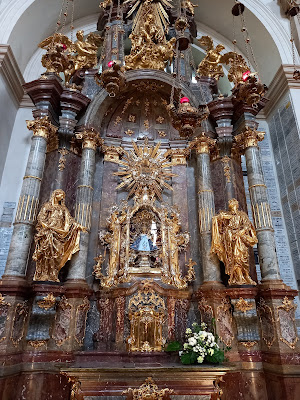
Not weird at all

We crossed the Charles Bridge, which is decorated with statues old and new, and continued on to the Old Town Square. This contains the famous astronomical clock on the side of the Old Town Hall. From there we admired the rest of the square, including the Church of Our Lady before TĂ˝n, which is now obstructed from view by TĂ˝n school, that someone unbelievably thought would be a good idea. 

The astronomical clock

There are loads of churches, nearly all with spires, in Prague, which give the city one of its nicknames, City Of 100 Spires (there's probably more, but City Of 473 Spires doesn't have the same ring). Despite this, Czechs are proud to boast of their atheism - our guides have variously given figures of 75 - 85% of the population declaring they have no religion in a recent census. This goes back to before even the Communist era, but to the 30 Years' War (which they lost, having started it with the Prague Defenestration), and being forcibly converted to Catholicism. This seems to have given them a distaste for the whole religion thing. Nearly all the churches are no longer used or converted to museums these days. They are however maintained by the state as part of the city's history.

This about ended the tour. Igor suggested we join him at a restaurant belonging to one of his friends, just along from the Old Town Square and on the way back to the hotel. There we tried some becherovka, a Czech vodka flavoured with a secret blend of herbs and spices (cinnamon was prominent), and then stayed for lunch and a glass of Pilsner Urquell, one of Czechia’s national beers. Afterwards we wandered round some of the old squares, including Wenceslas Square, then headed back to the hotel, along the way noting places as possible venues for tonight’s dinner.

Tomorrow we set out at sparrow fart to see if Sleazyjet can convey us back to the UK.