Showing posts with label tour. Show all posts

Monday, June 1, 2026

Bosnia & Herzegovina

Another early start, another country…we’d booked a tour to Kravice waterfalls and Mostar. There are three options: standard tour, on a bus, up to 50 people; medium tour, midi bus, 18-25 people; or small group, up to 10 people; each priced accordingly. We opted for the mid-sized tour, but when the bus turned up, it was a small one, as only eight people had booked, so we were quids in already. As the first pick-up at 7:00am, we had the choice of seats, and picked the front with our driver and guide, Angelko, as this had the best views. We stopped off for three other couples – one from Norway, one from Ireland, and one from Australia, then set off. Our fellow tourees were not a sociable bunch, so we didn’t have much chat with them on the way. Angelko pointed out some interesting features along the road to the border to BiH, as it is abbreviated. This was fortunately not as arduous as the first crossing into Croatia, but we still had to do the facial recognition scan.

As we drove along, Angelko pointed out the road signs. These are in both Roman and Cyrillic scripts, but due to ongoing tensions between the two communities, many of the Cyrillic parts of the signs have been spraypainted, painted or taped over so that they are illegible or invisible. I guess this is done by the same sort of people who paint George crosses on roundabouts in the UK.

We headed straight to the waterfalls. These are picturesque, and we’d brought swimming gear, but when we got there no-one was swimming and the changing rooms weren’t immediately apparent, so we took pictures – including the fish in the lake and some strange insects, which turned out to be Beautiful Demoiselles (Calopteryx virgo meridionalis) – then sat down and had an ice cream instead. Then some people started swimming, we found out where the changing rooms were, but by then we’d decided we didn’t really have time any more, as we still had to ascend the 173 steps up the hill to the car park. There was supposed to be a road train but we’d not seen any sight of that either, so we slogged up the hill. Whilst there’s been some development here – a few cafés and stalls – a little more effort would go a long way. Angelko told us there was talk of a major hotel being sited there, but there’s objections from locals, and that may be an overdevelopment. 


Come here, little fishy!


One couple wanted to go to Medugorje, which had been an option on our trip, so we took a detour there. We didn’t have time for the full ascent of the mountain, so just stuck to the town. A service was in progress at the church, with loads of people sitting outside as it was full. The town itself is a temple to the gullible: loads of shops selling religious tat. Many people in wheelchairs were there, presumably to be cured. The whole place is a depressing reminder that people will believe anything. 

Bags of tat

Shoploads of it

The church is nice, though

A short drive away is Mostar. This is a city that featured heavily in news reports in the early nineties, being the scene of some of the main conflicts in the Balkan war of 1991-1995. There are several museums about the war in the own, but frankly we've had enough of grim stuff in Albania. Some of the buildings still bear the scars of that war. We spent three hours in the Old Town, including lunch at a restaurant recommended by Angelko - Foodhouse - where we also got a welcome drink (rakia – what else?) and complementary dessert (apple pie) as well as our choices of lunch – dolma and Ćevapcici. After lunch we wandered the Old Town, bought a turtle and an evil eye, and looked for but missed the divers who jump off the Old Bridge. They basically ask tourists for money, and when the pot reaches €50, they jump. What a way to make a living!    

The Old Bridge

 
Jewellery shops everywhere!


We had one more stop on the way back – the small medieval settlement of Počitelj, which has a fortress high on a hill. Again, we weren’t going to climb all the way to the top, so we admired it from afar. 


We then headed back through the border crossing, again being scanned. This whole area has a confusing number of border and currency arrangements: some are members of the EU, some are also in the Eurozone, some are not members of either, some are not members but use the euro together with their own currency, and some aren’t members of either but only use the euro anyway. There’s a word for this: Balkanisation. We were fortunate to be spending euros and getting change in euros (not a given – some places give change in the Bosnian Mark).

We made it back to the hotel by around 7:30pm, so we’d been out for over 12 hours. We found in our room yet another bottle of wine and a written apology about the cleaning! I mean, guys! Last night’s was enough! Oh well, waste not, want not…

On our Italian trip two years ago we visited Slovenia, so with today’s excursion we’ve now knocked off five of the seven former Yugoslav republics. Just Kosovo and Serbia left…unfortunately we’re not going to get to them on this visit.


Saturday, May 30, 2026

Thrane Of Gomez

The next day we took it easy. The last fortnight has been, if not a punishing schedule, one of long trips on coaches, walking tours, and strange new beds, which had been taking a toll on my back after a while. We had planned to take an island tour today, but have now rescheduled that for Monday. As it turned out, the day wasn’t too flash weather-wise, with thunderstorms in the afternoon, so we may have done ourselves a favour there. 

The following morning we were up with the ubiquitous swifts that swoop around everywhere we’ve been so far. To what end? To get to the Old Town before the inevitable cruise ship disgorged its masses of unruly tourists. We got there a little before 8:00am and so were able to get some photo opportunities on the steps of the Walk Of Shame, and elsewhere. 

Nicola's Walk Of Shame


At 9:30 we joined a Thrane Of Gomez tour around the city. This is extremely popular in Dubrovnik – our group (one of three setting out at the same time from the same company; other companies were also running tours) contained 25 people, which I feel is slightly unwieldy for a walking tour. We had headsets so we could hear our guide, Dražen (pronounced Dražen). He first checked who had seen GoT. I confessed to only watching the first season, which was filmed in Malta, not Croatia, so most of what he was talking about was lost on me. Nicola knew what it was all about though.

He took us through the gate, down to the water, and up to the fortress, all the while talking and illustrating the scenes that were filmed in each location with stills from the series. He also told us that he’d been an extra (Peasant 57, apparently), and can identify his two seconds of actual screen-time. He explained about the filming process as well, what it’s like to be on set on such a large production, and the difficulties they faced; particularly in later seasons when the popularity of the show had increased tourist numbers to the city dramatically.


Dražen tells it like it is


Near the end of the tour he took us to the famous steps, which were by now thronged with people, both tour groups and general tourists. The chances of getting a decent shot were slim so it was a good job we’d been there earlier. 

We finished our section of the tour after two hours (“that’s enough GoT” – Ed), but most of the group had booked the longer, three-hour version which involves a ferry ride to Lokrum Island, and a photo opportunity on the Iron Throne, which we missed. Instead we strolled around and found a location for lunch: Zurori Restaurant, where they delivered a beer, orange juice, spaghetti vongole and salmon salad for €59.80. The spaghetti was €19.90, or NZD40. To paraphrase Vincent Vega, “that’s gotta be some pretty fucking good spaghetti”. <Morgan Freeman> But, it was not pretty fucking good spaghetti. </Morgan Freeman> 

After lunch, we visited the Aquarium, where (shock!) they had a variety of local fish in tanks. No super-big enormous tank like many modern aquaria have, but a good variety...some of which looked quite tasty! We didn’t spend long there. 


When you swim in the sea, and an eel bites your knee...

I'm going to call you...dinner


We then set out on a shopping expedition. Nicola’s suitcase has become quite decrepit after many decades’ service, so we headed to a shopping centre for an upgrade. We found one, but then had to find our way back to the bus route 4, which was a 14-minute walk in the afternoon sun. We made it though (obvs!) and arrived back at the hotel to cool down with a dip in the pool.  


Friday, January 10, 2025

Farewell Spit

We rose with the lark. Actually, well before the lark. Farewell Spit Eco Tours take you along Farewell Spit at low tide, when the intertidal zone is available, in specially-adapted buses, so the time of departure is dependent on the tides and varies by half an hour each day. On the day that we had selected low tide was early in the morning, so we needed to set out from our accommodation by 6:15 to get to Collingwood and register in time for a 7:00am departure.

We actually made it in plenty of time as there’s not a great deal of traffic at that time on a Tuesday morn in Golden Bay. We met our driver and guide, Allan, who gave us a running commentary about the history of Golden Bay and the wildlife throughout the tour.

Our first stop was at Fossil Bay, famous for its fossils. These are mainly sea shells in sandstone – the sand is made of worm poo. We saw variable and SI pied oystercatchers along the way. We then drove up along the beach in the intertidal zone. This is the best area for driving, although it is prone to quicksand – waterlogged sand which can drag an unwary vehicle down. This was evidenced by the pools appearing in the tracks of the bus in front of us (we were in two buses) as we drove up the beach. Driving is forbidden above the high tide line, as this is where the sand dunes are forming. It’s also highly inadvisable – in fact the trickiest bit of driving is getting from the road through the soft sand to the firmer sand near the sea. Allan was at pains to point out that this is where we were most likely to get stuck in the sand and need a tow from the other bus, although as it happened we didn’t get stuck at all on our tour.


As well as driving for FSET, Allan works for Department of Conservation, so whilst we were driving along he was taking observations of the sea life as well as pointing it out to us. In particular, he was noting oystercatchers with chicks, as well as checking on the status of the rotting carcasses of some whales along the beach. We were driving along the outer beach, which is not where the whales beach themselves – that’s the inner beach – but some of them are dragged on to the north side. There were also the stinking remains of a sperm whale, which had died at sea and been washed up here. As well as oystercatchers we saw black-backed gulls, ruddy turnstones, Caspian and white-fronted terns, and pied shags.

Our destination was the lighthouse which is almost at the end of the spit. The end of the spit is too unstable to support a lighthouse, or indeed any kind of structure, so it’s actually some way back from the end, and there are some other houses there as well, originally built for the lighthouse keepers. Originally it required a crew of three, with their families, to keep the kerosene light burning, but this was reduced to two when they installed electric lamps (not bulbs, apparently), and then one; and finally it was completely automated in the 1970s and is now run from Maritime NZ in Wellington. The houses are still there, though, and used by DOC and Maritime NZ to house researchers and maintenance workers.


We stopped there for a while and learned the history of lighthouse keeping, accompanied by hot beverages and muffins. There are signs at the base of the lighthouse saying “No Entry”, but, as Allan told us, “I’m not your dad and I’m not your teacher”, so if you choose to disobey the sign, go ahead…and many did. He enjoined us not to post pics on social media as Maritime NZ would soon figure out where they came from and he’d get in trouble. It’s quite picturesque around there as the first lighthouse keeper, after failed efforts to grow anything in the sand, had transported soil from Collingwood – two sacks at a time – on his fortnightly trip to town for supplies. Eventually he had enough for a vegetable garden and orchard, and planted a few trees as well.

At this point we’d normally turn around and go back, but a little further on is the gannet colony – the second-largest in New Zealand. Unfortunately we couldn’t get close but we admired them from a distance. We then turned around and headed back the way we’d come.

We stopped near the sperm whale corpse and climbed a dune, from where we could see to the south side, the inner beach, in the distance. At high tide, twice a year during king tides, the spit narrows down to a mere 200m, but most of the time the spit is between four and 17 km wide.


Our final stop was at Cape Farewell, which is at the base of the spit and is the northernmost point of the South Island – well north of Wellington, in fact. There is a spectacular arch visible there, and we saw two fur seals.

We ate our packed lunch here, before heading back to Collingwood, with Allan continuing his running commentary including how high-end restaurants in LA and New York dine on New Zealand littleneck clams caught and processed locally and airfreighted to the US in refrigerated containers. It’s big business, apparently.

We arrived back in Collingwood after around 7 hours on and off the bus, and headed straight back to our motel to rest. In the evening we checked out local Thai diner O’Sha, recommended by the motel owner.


Thursday, May 2, 2024

Milan

This is our last day in Italy. We didn’t have the early start that has characterised our previous hotel departures – instead, we left at a more sedate 9:30am. This allowed us to make the short journey to Modena, and Luciano Pavarotti’s house.

Pavarotti was born in Modena and maintained strong connections with the area. When he retired he built a house on the outskirts, where he lived the remainder of his days. Whilst doing so he set up an academy for young singers, and taught or coached promising young opera singers. We toured the house, which is full of memorabilia, costumes, Grammys, platinum records, scores and books. Once we’d completed the tour we were treated to a concert from two up-and-coming singers: Yolanda, a soprano, and Giuseppe, a tenor, who gave us renditions of arias from various operas, accompanied by a pianist. Afterwards they stayed for interrogation by members of our group.

After the concert, we crossed the road to the restaurant attached to the house, for our very last traditional Italian lunch: antipasto, this time with hot bread pillow cakes, followed by risotto with balsamic vinegar (we are in Modena, after all) and roast chicken breast. Pudding was a vanilla ice-cream with caramelised peanuts.

We boarded the bus for the trip to Milan. We had about an hour to ourselves in Milan, to look around. This was hampered by (a) it being Mayday, so most of the shops were shut; (b) a demonstration outside La Scala opera house, requiring a police presence and road closures; and (c) it was raining. We wandered around a bit, then met up again at the agreed rendezvous outside Tiffany’s. As ever, one of our group was completely lost, but we managed to find her on the way back.

The big thing in Milan

The big shopping place in Milan

Our final journey was to the airport, about an hour out of town. We checked in, nd headed up to the lounge. Six hours to Dubai, then 16 hours to Auckland. Home on Friday.


Bologna

On our final full day in Italy, we had a bit of a rest in the morning, with no engagements. A chance to catch our breath, before heading to Bologna for a tour of the city, followed by an early dinner and the final opera of our tour, Tosca.

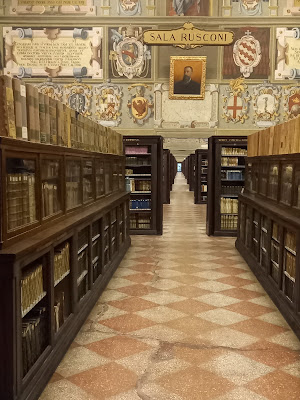
In the morning we had a final wander around Reggio Emilia, a coffee in the café outside our hotel, and then boarded the bus for Bologna. There we met our guide, Julia, who told us all about Bologna. The city doesn’t have quite the same cachet as some of the other cities that we’ve been to on our tour, but still there were some interesting points. It’s another city with an ancient university – this one reckoned to be the oldest in the Western world, having started in 1088. Some of it was damaged during WW2, but has been reconstructed as much as possible. Where the frescoes were unrecoverable they’ve simply painted white, not wanting to create a “fake antique” look. There was an anatomical theatre, where demonstrations of dissections were carried out, watched over by statues of Anatomia and all the forefathers of medicine – Galenus, Hipoocrates etc.


The new library, on the site of the old library

The really old library

The tour was then interrupted when one of our number was knocked down by an unheeding cyclist. She sped off into the distance, leaving Mike on the cobbled street. Fortunately one of the bystanders was a doctor, and within short order he was off to hospital for an x-ray. He turns out to have a broken hip, so not a good end of the holiday for him. This necessarily cast a downer on the rest of the day’s proceedings as people wanted updates on how he was doing. I managed to get a picture of the perpetrator speeding away, so hopefully the police can use that to help identify and bring her to justice.

We then had a look inside the big church – not the cathedral, that’s elsewhere – and it’s full of big church things. It’s one of the largest churches by volume in the world due to its 45m height. But it also contains science, in the form of a meridian line, which is lit by the sun through a tiny hole in the roof at local noon.  

Inside the big church

After a bit of free time – we found a café and I had a Negroni – we met up again for an early dinner; yet another plate of antipasto followed by tortellini. Not having had anything to eat since breakfast, we fell upon this like the wolf on the fold.

After dinner we quick-marched to our bus again, as we were running a little behind schedule. This was exacerbated by the bus driver taking a wrong turn, and also the fact that Kelly had gone straight to the venue from the hospital – she’s our main Italian speaker among the guides, and the driver didn’t have much English. We made it through with a minute to spare, and Kelly greeted us, handed us all tickets willy-nilly, and we sat down straight away.

The opera, Tosca, was well executed but no particular new settings or surprises. Scarpia was particularly loathsome. Spoiler alert: she dies at the end.


Wednesday, May 1, 2024

Aceto Balsamico

Aceto Balsamico Di Modena is a thing that we all know. For many centuries, no-one took much notice of it. It’s produced in a long and involved process taking many years, nay decades, in the lofts of various farmhouses in the region.

Then, one day, someone revolutionised the process, industrialised it, and copyrighted the name. This is what’s sold in shops around the world as balsamic vinegar, and it bears about as much resemblance to the real thing as Nescafé does to espresso.

We went to the Cavazzone farmhouse, which is owned by Umberto Sidoli, who also owns the Hotel Posta. The farmhouse was originally built for Baron Franchetti. After he died, it was bought first by the architect, then by the Sidoli family. Why was it sold? The baron’s children basically pissed away his fortune. Umberto’s great-grandfather bought it in 1919, and it has been in the family ever since.


 In their loft they produce the traditional balsamic vinegar. They can’t call it “of Modena” because that’s copyrighted, but theirs is the original and genuine product. Grape juice from four different varietals is boiled up, fermented, then barreled in a series of five different woods – oak, cherry, mulberry, juniper and chestnut – and left to mature for decades. It doesn’t matter what order you start with the barrels, but once you have, it’s fixed for that series of vinegar. The barrels are uncorked but covered with linen cloth, and evaporation happens over time. Once it’s ready, maybe five, 10, 20, or even 30 years later, you can take up to 1/3 of the liquid from the final barrel. You then top up from the next-most-recent barrel, which is topped up from the third, etc. etc. This means that the liquid sold is described as, for example, “at least 20 years old” rather than giving an exact year, as it is constantly being blended. The final product is a rich, thick, syrupy liquid, nothing like what you buy in a supermarket.

The ageing loft

After explaining all this, as well as the history of the house and his family, Umberto took us downstairs for a tasting of the differently-aged vinegars. As they get older, they get sweeter, more syrupy and complex in flavour. We tried one of them accompanying boiled eggs and parmesan cheese. This was followed by a pasta-making demonstration from our chef. He showed us how to make the pasta, then rolled out some he’d prepared earlier and showed us how to make tortellini, and similar filled pasta, as well as tagliatelle and other grades of ribbons.

This was all making us very hungry, and we sat down to a dinner in the restaurant – a typical Italian dinner. This time we had both tortellini and risotto with asparagus after the antipasti, and finished on roast pork with – you guessed it! – balsamic vinegar, and finally panna cotta with a balsamic glaze.

That concluded our education in balsamic. We reboarded our bus and went back to the hotel.


Tuesday, April 30, 2024

Reggio Emilia

We arrived in Reggio Emilia late in the afternoon? Reggio where? Although classified as a city, it’s more like a small town, in the heart of the Emilio-Romagna region of Italy. It’s famous for its cheese production – it is the centre for Parmigiano Reggiana. Hotel Posta is the former horse post from days of yore – in fact some parts of it date back to the 16th century. The current owner is the 4th generation of the family to own it - about which more later.

We were up with the lark to take a short bus ride to a local cheese factory. We were all on time, this time it was the bus driver who was late. He blamed traffic. There is no traffic. Anyway, we were soon all aboard and on our way to the factory. We’d missed the beginning, and were fully prepared to face the wrath of our guide (apparently last year when they were late, they were roundly scolded), but this time it was all smiles…either they’d sacked the previous guide, or they’d been on a Customer Service course since then.

We’d missed the milk delivery part of the tour, but joined in where they were heating up the milk then adding rennet to create curds and whey. Our guide, Anne, explained the cheese-making process, which is roughly similar to all other cheese-making processes. She was at pains to point out that what makes parmesan unique is the grass and other feed the cows eat, and that it only comes from this specific area. After draining and being put in moulds, at this stage a special band is placed around the cheese, imprinting it with Parmigiano Reggiano, the date, the factory and batch numbers. This only stays on for 24 hours and is sufficient to stay on the cheese for the rest of its life. It’s immersed in brine for 24 days, by which time the salt has penetrated 3 inches into the cheese. The rest of the salting process takes place by osmosis after the cheese is taken to the warehouse, where it matures for a minimum of 11 months, making a full year including all the other bits. Usually, however, it’s aged far longer than that.

Beaucoup de lait, pas de fromage...

Beaucoup de fromage, pas de lait


The smell when you walk into the warehouse is amazing, and Anne invited us to described the odour, including notes of citrus, pineapple, leather, and mould. Mould, of course, is the enemy here, and the cheeses are regularly brushed and turned on the shelves. They are also tested to ensure quality, and any that fail the “knock test” (with a special hammer to detect cracks/hollowness) are scored around the rind – effectively marking the cheese as being 2nd grade. If it’s too bad, the scoring is particularly tight, crossing out the words entirely. If you see scoring on the rind of your parmesan, don’t buy it.

There's a lot of cheese!

We then went through to taste two cheeses, a 24-month “young” cheese, and a more mature 40-month. We compared the differences in texture, flavour, and saltiness.

Colour is not an indication of age

We returned to Reggio Emilia and Anne took us for a walking tour of the town, pointing out sites of interest. It doesn’t have the churches and architecture of the larger cities we’ve been to, but is more a model of a typical Italian city where the ordinary folk live.  After a light lunch at Macrame, we were left to our own devices for a couple of hours, before rejoining our bus to the Cavazzone farmhouse, there to find out about vinegar.

The big church

The theatre - Pavarotti gave his first performance here


Monday, April 29, 2024

Padua

We left our hotel almost on time. We’d arranged an early start to incorporate the time booked into the church in Padua, and nearly all of our group had actually got the message and complied. But there’s always one*…”Oh, I didn’t hear that”.

We left the beautiful, 5-star hotel Savoia Excelsior Palace Hotel for the last time, with many a tear in our eyes. The drive to Padua took around two hours, and we arrived to meet our guide, Michaela. Hold on, I know that name…yes, it’s the same guide we had in Venice. She took us around Padua, explaining its importance as a Roman city (the third largest in the empire). It’s also home to one of the oldest universities in the world, founded in 1222. We took a look around some of the oldest parts which are still extant – now home to the university’s administrators rather than students. It also has a very old café which never closes its doors – a very early 24/7. It also has an astronomical clock with an unusual feature – instead of the traditional 12 signs of the zodiac, it only has eleven – Scorpio occupies two sections (there’s no Libra). Legend has it that this is because the creator was never paid for his work, so decided to deliberately ruin it.


The old Justice building...now a market

Zoom in on Scorpio (3 o'clock)

We then made our rendezvous with the Scrovegni chapel. This was built by a wealthy banker in an attempt to improve his image. Bankers were held in low regard despite being wealthy – Dante put them in the seventh inner circle of hell with the usurers, so spending a lot of money on a chapel was a way to increase their standing. He employed the best sculptors and fresco painters of the day – some chap named Giotto did the paintings. This is what the chapel is now famous for; the rest of the palazzo has been demolished, and attempts made to remove the frescoes and sell them off were thwarted by the city council, who eventually raised the cash to buy what remained, and make it a public gallery. The system here is quite regimented: You turn up at your allotted time, watch a 15 minute video (in Italian with English subtitles), then spend 15 minutes in the chapel, as Michaela explained the significance of the frescoes, what they were depicting, and the influence on Western art. After 15 minutes you’re marched out so the next group can come in.

Heaven to the right, Hell to the left

We had a short lunch break, then found our way back on to the coach (guess what? Some of the group were late), for our onward journey to our final stay, the small town of Reggio Emilia. We’re staying here as it’s in the heart of cheese-, ham-, and vinegar-making country. So guess what? Tomorrow, we’re off to a cheese demonstration and tasting. Blessed are the cheesemakers!


* Not always the same one, but there's a small group of offenders

Sunday, April 28, 2024

Trieste

Today is Trieste day. We were met by our local guide, Daniella, and went on a walk around Trieste in the spring sunshine. OK, spring overcast. Most of the locals were still in puffer jackets, scarves and boots, but I braved it in shorts and short sleeves…it was brisk, sure, but not winter.

We started off in the main square, which is full of main square-type buildings. Daniella explained the history of Trieste, how it became the second-biggest port in Europe when the Austro-Hungarian empire was at its height. Students of geography will note that Austria and Hungary aren’t famed for their coastlines – the Habsburg empire had very little coastline, so when Trieste (then part of Slovenia) came under their rule, they expanded the small village to a huge port city. After the end of WWI, it was decided that Trieste would become part of Italy, and started to decline – Italy already had ports! In fact, Italy is almost all coastline!

Square-type building

Another square-type building

We visited the site of a Roman theatre, which was excavated during Mussolini’s time – he was big on Roman stuff, and was keen to show that Trieste had always been part of Italy, not Slovenia. We also visited two Orthodox churches: one Greek, and the other Serbian, full of mosaics and other churchy stuff. We also crossed the Grand Canal – basically an extension of the port so that goods could be brought further inland. Much of it has now actually been paved over.

The Roman theatre


Greek Orthodox church

 
Serbian Orthodox church

We also stopped by a statue of James Joyce. He lived in Trieste before the outbreak of WW1 – indeed, he and his wife Nora had just started decorating their apartment with the intention to remain – when war broke out and he returned to Ireland. He’d already written the first chapter of Ulysses here, and if he’d remained, who knows? We might be calling the author Giacomo Joccio. He returned after the war, but then said he no longer liked it.

We had an hour’s break for lunch, so selected a restaurant right next to the hotel. The breeze was still a bit fresh so we asked if we could sit inside? “No”. No explanation, no apology, just “No”. Ah well. We ate pasta and drank local beer.

Local beer

At 1:30pm we reconvened, this time to explore the outer regions of the city by bus. Our first stop was at the top of a hill, where two churches had been amalgamated into one. They date back to the Middle Ages originally, and contain more mosaics borrowed from Constantinople, as well as relics of their saints – San Giusto and San Sergius. San Giusto may or may not be the person that St Just is named for, but no-one really knows.    

Basilica San Giusto

We drove on, and up, to a modern church situated at the top of a hill. Whilst the church had little to recommend it (60s brutalist concrete), the views from the top are the best in, and of, the city. On a clear day you can see Venice to the West, and Slovenia and Croatia to the south-west. We didn’t have a clear day but could still see a long way.

Trieste from above

Our final stop was the rose garden of the former lunatic asylum. Long since closed down, the garden is still maintained, with 5,000 different varieties of rose. But I’ve seen flowers before.

In the evening we had an early dinner at the hotel – finally! Some seafood!, then went to see Rossini’s La Cenerentola – Cinderella to you and me. Performed in a traditional setting, but very well done all the same, and jolly good fun. You know the story.