Monday, March 19, 2012

Pencarrow Head


We'd previously walked from Muritai along the coast track to Pencarrow Head, but had turned back as it's quite a long walk (4 hours) and we'd set out quite late in the day and weren't really prepared for a long walk. "We should hire some bicycles and do this" we said, and as we left the car park we spotted the cycle hire shed that had eluded us when we set out.

On Sunday we returned to Muritai, parked up and rented a couple of bikes. We'd packed a picnic in a cool bag, so redistributed that between two rucksacks - along with all the other requirements that we usually forget when we go out exploring and which are written on every map we see when we get to the park or reserve in question: Plan your trip, tell someone of your plans, wear proper shoes, take waterproof/warm clothing, take water and food with you. Normally when we set out we joke about how we would need to be rescued as we were wearing inappropriate footwear, no warm clothing, no food or water, hadn't told anyone, didn't know where we were going etc. But this time we done it proper, like.

I've not been on a bike for about 30 years, so I was a little unsteady to begin with. Also, the concept of gears on bikes was largely foreign to me, so I had to figure out what I was doing with those as well. Fortunately, your modern mountain bike is fairly intuitive in this, so I got the hang of it pretty quickly.

Christ on a bike! Well, me, actually


We set off down the gravel track towards Pencarrow Head, stopping along the way to admire the scenery and the lighthouse - New Zealand's first, which was manned, or womanned, by  New Zealand's only woman lighthouse keeper, Mary Jane Bennett.


We headed off the beaten track onto a more rustic one by Lake Kohangapiripiri, and sat down by the track to have our picnic.


The return journey was substantially more arduous as we were heading into the wind, which had picked up quite significantly. Also we were a bit saddle-sore by this point, so we stopped for a breather several times on the way back.

The overall trip is not a long one by cycling standards - I think it was about 8km each way. But it felt longer on the way back.


Tuesday, March 13, 2012

Zealandia


On Saturday, the sun was shining, it was warm, and we decided to go back to Zealandia, the wildlife park in the centre (-ish) of Wellington. Well, it's in the central Wellington area. I first visited Zealandia when Nicola's family were visiting, and we took advantage of their special offer for membership, which means we can go there any time we like without paying...for the next year, anyway.

We entered through the takahe enclosure. Takahe are extremely endangered - like many New Zealand birds, they were highly susceptible to predation by both humans and introduced mammals, and only survive on predator-free islands or in reserves such as Zealandia or Pukaha Mount Bruce. 


We then walked up the lakeside track to the tuatara area. Last time we were there we spotted four tuatara basking in the afternoon sunshine: 

A tuatara in typical pose. The coloured beads identify them to  the staff.

This time around, we only saw two - an adult male and a juvenile - whilst we walked along the front part of the tuatara enclosure alongside the path. But then we decided to take a different turn and walked up the back of the enclosure, an area which is not as sunny, in order to get to the high dam (Zealandia is built around what used to be Wellington's main water supply, until the powers that be realised the foolishness of having a water supply right on the main fault line under the city). We discovered that there were patches of sunlight here where the path curved, and saw two more adults out in the sunshine...then, when we were leaving the enclosure and heading off on a different track, some rustling in the undergrowth attracted us and we spotted another one outside the enclosure. So this was almost like seeing one in the wild!


After walking the high track and the Valley View track (from which we were unable to view the valley) we came to the bellbird and hihi feeding area, where, unsurprisingly, we saw several bellbirds and hihis. They're generally quite difficult to tell apart, but apparently the hihi has a tail which sticks up, whereas the bellbird doesn't.

By the time we'd completed the circuit our sightings of tuatara were a bit out of date (visitors are encouraged to note sightings on a whiteboard, to assist other visitors in spotting them), so we took a quick peek at the wetas in their weta hotels before heading back to the visitor centre.


Friday, March 2, 2012

Rotorua


The weather forecast for our three days in Rotorua was pretty grim: nearly all of New Zealand is in the grip of a huge swathe of rain, and we were right in the thick of it. Nevertheless, we decided that we should go out and explore the volcanic activity in the area, as this was after all what we’d come here for.

First thing to note about Rotorua is the smell. It whiffs. It pongs. It is everywhere, although it seems to come and go in gusts…but there’s always that background level of smell. You get used to it.

We drove about 27km south to Wai-O-Tapu Thermal Wonderland, which has a geyser that is set off artificially every day at 1015. We didn’t need to make an early start, but got on the road to make sure we could find it and be there in plenty of time, both of which we achieved with the minimum of fuss. The rain was coming and going in waves, but never completely stopped. We got our tickets to the whole park, including the geyser, and waited around n the light drizzle waiting for the show to begin. As it did, the rain got substantially heavier, and we all got somewhat soaked. The guide told the story of how the geyser had first been discovered by prisoners (it was on the site of an old open prison) and they’d used the hot water pool for washing their clothes. The soap they’d used had broken the surface tension of the pool and caused the geyser to erupt, distributing their laundry over a wide area. Nowadays they seed the geyser with an eco-friendly surfactant which has the same effect, and causes the geyser to erupt.

Who's this geyser?

Thoroughly drenched, we repaired to the café for refreshment and waited for the rain to ease off a little. This it duly did, and we went for a wander around the rest of the park, where that are various pools craters, and assorted deposits and other signs of volcanic activity. We were fortunate that the rain held off for most of the time, and only really set in again heavily when we were just on the last leg, so we rather rushed past those, and headed back to the café for a warming hot chocolate, and a trawl around the gift shop, whilst trying to dry out a bit.

This is where the café gets the hot chocolate from


On the way out, we drove past the mud pools, the final part of the tour. As it was starting to rain again, we decided to give it a miss, and this was vindicated as a truly torrential downpour then ensued as we made our way back to central Rotorua. By the time we got there we were pretty hungry, and we selected Fat Dog Café more or less at random – a good choice, as it turned out, and we had a substantial lunch there. We then set out in search of the fabled Rotorua t-shirt (all the gift shops we’d encountered so far only stocked general New Zealand t-shirts – I was after something more specific!) and had a walk around the Government Gardens, which contain some hot bubbling pools and a now-defunct geyser.

Cute baby pukeko in the Government Gardens

Wednesday, February 29, 2012

White Island


We’d booked our trip to White Island many weeks ago. Sacha had expressed an interest in seeing some of New Zealand’s geology, so we thought a visit to an active volcano would be just the ticket. The boat leaves from Whakatane at 0915, which is about an hour’s drive from Rotorua, so we were up and out of the house before eight for the drive. It was raining, but we weren’t about to let a little thing like that stop us: we’d contacted the tour operator the night before, and they’d told us to call early in the morning for a final check on whether the trip was going ahead. They gave us the green light, and off we went.

We got a bit caught up in commuter traffic as we were entering Whakatane, but made it to the White Island rendezvous with ten minutes in hand – enough time to read the somewhat frightening disclaimer of liability, and sign away our rights to blame the company if anything goes wrong. “It’s a live volcano: if it erupts, it’s not our fault.” We boarded the boat, the Pee Jay 5, with around 50 others, and took the long and choppy ride out to White Island – a trip of about 90 minutes. A few people, myself included, felt a bit queasy on the way out, and had to be seated outside at the rear of the boat, looking back at the horizon.


Before leaving the boat, we were given another safety talk – what to do in the event of an eruption or landslide. We were also issued with hard hats and gas masks, and instructed in their use. Then it was off to the island on a RIB, as there isn’t anywhere suitable for the Pee Jay 5 to moor.

The island has been previously inhabited by sulphur miners, and has been owned by various people before the current owners, who have an agreement with the Government to keep it as a conservation area. The tour around the island led us round some active steam vents, where the sulphur condensing was clearly visible, as well as bubbling pools of water. The smell of hydrogen sulphide was pretty strong, but the vents also give out sulphur dioxide and hydrogen chloride, which when mixed with water form sulphuric and hydrochloric acids respectively – this catches in your throat and makes your eyes water. When you get a waft of it towards you, you realise that the gas masks aren’t just for show, and we were all wearing them for a lot of the time whilst walking around the active areas. We went up to the edge of the current active crater, and looked down at the activity below. The island is classified as active class 1 – which means that thee are signs of activity but no eruption imminent. If the volcano was closer to human habitation it would be class 2, but its remoteness knocks it down a grade.

Steam, sulphur dioxide and hydrogen sulphide comes out of the ground

Those gas masks aren't just for show!

Boiling mud pools


The tour also gave us some insight into the lives of the sulphur miners who used to live there, and the ruins of the sulphur works (abandoned in 1933 when the company went bankrupt). Amazingly, there is both plant and animal life on the island – grasses and pohutukawa trees, and colonies of seabirds, notably Australasian gannets.

Industrial archaeology

We had a packed lunch back on board, then set off back to the mainland with a much smoother ride, as the swell and the wind were behind us. We got back around 4pm, and went to find a cake and teas/coffees before driving back to Rotorua. We’d been lucky with the weather all day as, although showers had been forecast all day, they held off whilst we were on the island, and it only rained whilst we were aboard or driving.

Tuesday, February 28, 2012

Tauranga


We cleaned the bach, packed our bags and hit the road early, to drive down to Rotorua via Tauranga. We wanted to call in to visit some friends of Sacha’s who’d emigrated to New Zealand last year. We stopped along the way at Matamata for coffee, then took a longer break at Karangahake Gorge, an old 19th century gold mining site which now has interesting walkways through the old mine works and up the river. Part of the walkway is through tunnels drilled into the rock, for which a torch is advisable. We didn't have a torch, and it was pitch black inside - you literally had to feel your way with arms outstretched to feel the sides of the tunnel before you got round a bend from which daylight was visible. 

Phew! Daylight!


We spent a couple of hours at the gorge, which also had several bridges of a suspension type which were a bit wobbly - the sign said maximum 10 people.


We stayed for lunch at the café before setting off for Tauranga and arrived at mid-afternoon. We’d thought that we’d be able to find the street where Sacha's friends lived quite easily, but had been hampered by the fact that there was no wifi at the bach, and so had been unable to look it up on the internet. You don’t realise how much you take it for granted these days, until you haven’t got it! Tauranga is New Zealand’s 6th  largest city, and also its fastest growing. Fortunately, we were able to follow road signs to an i-site, and get a map from there. It turned out that it was really easy to get to, and if we’d just carried on driving we’d have found it by blind luck.

We drove down to the wharf to the fresh fish market, and ordered fish & chips from the eatery there. They serve fish of the day, freshly caught, with chips on trays – none of you fancy-schmancy “plates” and “cutlery”! It wins awards every year as "best fish'n'chips" in the Bay Of Plenty. Lucinda had thoughtfully brought cutlery for all of us, as well as some cold Speight’s, tartare and tomato sauces, and vinegar. We sat outside on the dockside, our every move watched by a large flock of seagulls, who doubtless make a living by snatching food from the unwary and inattentive.

Afterwards we went for a walk along the beach towards Mount Maunganui, where a surf boat race was in progress; 

Mount Maunganui
and then had to take our leave as we wanted to get to Rotorua before night fell, in order to get into our next bach. The instructions for getting the key were somewhat convoluted, and we didn’t really want to be trying to find it in the dark! We found it with no trouble, and unpacked ourselves, nipped out for some necessary groceries from the local garage shop, before having an early night: we had a long day ahead of us tomorrow.


Monday, February 27, 2012

Hot Water Beach


One of Coromandel’s attractions is Hot Water Beach, where you go out at low tide, dig yourself a hole in the sand, and sit in the water which is heated by geothermal activity just at this one point on the coast. We’d checked the tide times, and equipped ourselves with a couple of shovels from the bach. Low tide wasn’t until midday, so we drove up the coast to a local Kiwi reserve we’d spotted the previous day, and took a walk around the loop track into the forest. The Department of Conservation gave the walk as one hour, but we covered it in less than half that, even stopping along the way to admire the trees and wildlife. We concluded that the DOC estimated times at the pace of the slowest, and that they’d found some guy with a Zimmer frame to time the walk. This was information that would come in handy later on in the week.

We had time on our hands, so drove around the long way to Whitianga and stopped there for a coffee before heading back to Hot Water Beach in time for low tide. There were upwards of 100 people doing the same thing – and this on a Monday, when we thought it would be less crowded than at the weekend – so we tried to find a suitable space to dig. Unfortunately, the dictum goes that if you find a spot where no-one else is digging, this is usually because it’s too hot there, so everyone crowds into one small area. Fortunately we found a hole that was about to be vacated by some Danes and were thus able to take freehold possession of a “pre-loved” hole in the sand. Some areas in it were quite hot, but with a bit of judicious swirling around we managed to get an even temperature. We undertook a bit of remedial digging to re-establish the walls, and sat down.


Then you just sit in your hole of hot water. After a while, this does become a bit tedious, so we didn’t stay very long. We washed off the sand in the sea, got changed and headed down the road to get some lunch.

The Purangi Winery had been recommended to us by Hayden the day before, as they not only sell wine but also create a range of liqueurs and spirits, and have a wood-fired pizza oven. We went to the tasting room and tried the wines – indifferent Chardonnay, Sauvignon Blanc and Pinot Noir, and then spirits, which included feijoa, boysenberry and plum liqueurs, gin, slivovicza and arraq, “Old China” ginger wine, and feijoa cider. Sadly I had to take only tiny sips of these as I had the car keys. 


Our host told us all about the history of feijoa and kiwi fruit in New Zealand, as well as giving random information on all the subjects under the sun, and showed us his weta (dead), Maori adzes and gizzard stones from moa that he’d collected. He was a bit of a character and talked nineteen to the dozen, and was very enthusiastic about all his products. We bought some feijoa liqueur to take with us, and went next door to order our pizza. We sat down in the sunshine, where we watched a life-and-death struggle between a cicada and the spider into whose web it had flown. Every time the spider came near the cicada kicked and struggled, and the spider was unable to inject its venom, and backed away. Eventually the spider got past the kicking and from then on it was only going to end one way. We debated whether to set the cicada free, but decided that nature must take its course. We wondered whether the spider would take his kill home proudly to Mrs. Spider, who would then say “and how d’you expect me to cook that?”

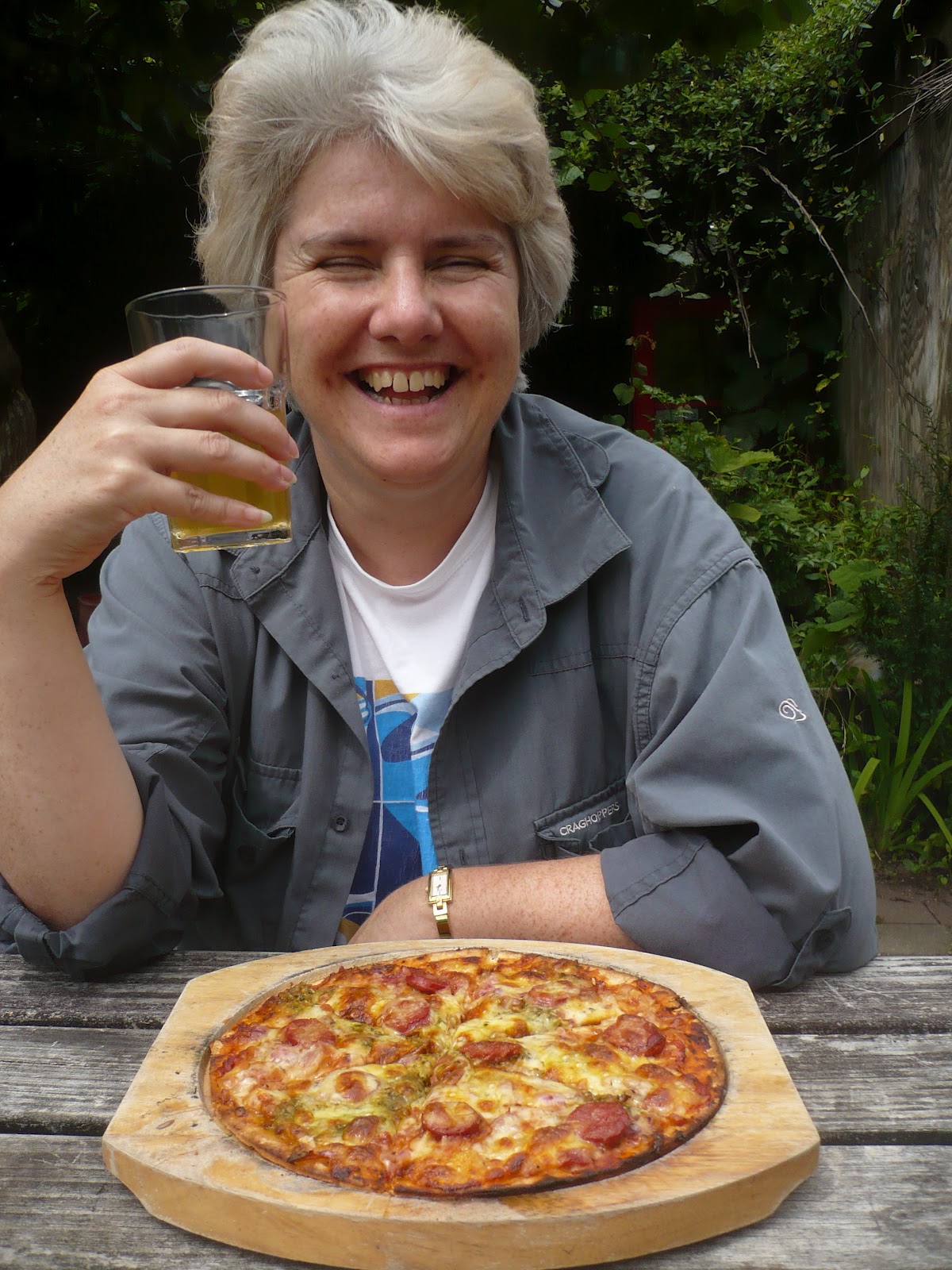
The pizzas arrived, and were delicious.


Sunday, February 26, 2012

Cathedral Cove


The day dawned bright, sunny and warm, and after a leisurely breakfast we drove out to Cook’s Beach, where we took the ferry across to Whitianga. Whitianga is a typical small New Zealand town, and after second-breakfasting at a café we wandered around  the town, in search of souvenirs for Sacha and Lisa to take back to their families in the UK. At around midday we crossed back via the ferry and drove to the beach and went for a quick swim in the Pacific Ocean, before locating the Cathedral Cove tour operators and having a quick chat with them about when they were going to set out. Turned out we had a bit of time to spare, so we swam around a bit more before returning with a few minutes to spare.

Our guide to Cathedral Cove was to be Hayden, and our means of transportation was sea kayaks. Firstly he demonstrated how to hold our paddles, then how to steer the kayak (foot pedals attached to the rudder), and got us strapped in with skirts and life jackets. And then it was launch time – Hayden pushed us out and we paddled like mad to get about 40m out to sea, beyond where the waves were starting to break, and waited for the others in our group – Sacha and Lisa in one kayak, and a Malaysian couple in the other, as well as Hayden himself in his one-man kayak.

Sacha, Lisa, and me


We then paddled around to Cathedral Cove by way of some other bays – Stingray, Shakespeare's and Gemstone Bays, and another bay where we went into a cave that was forming in the volcanic rock that makes up the cliffs. Hayden led us through some reefs where we had to be pretty quick to get through on the waves, and occasionally got us together to form a raft by holding onto each other’s boats so he could give us a bit of info about what we were looking at, how the rock formations and caves were formed, and some Maori legends about the place. The whole area is also a marine reserve and the sea life is doing very well, apparently, although none of it turned up to greet us (which does happen every 2-3 weeks, so Hayden informed us – in the form of pods of bottlenose dolphins). We had to steer around snorkelers and divers as this is also a popular spot for them.

Before we landed at Cathedral Cove, we formed a raft again and Hayden briefed us on the hand gestures he would use to guide us in: when to paddle, when to stop, and when to go backwards. This is to avoid being caught by a big wave behind you as you come in to the beach. As he put it “if you try and surf into the beach you’ll look cool for about three seconds before turning sideways on and rolling over in the surf”. Not a good look, and of course potentially dangerous, so we dutifully followed his instructions and landed without incident. When we were all on the beach, he took our coffee order, then went off to brew coffee and chocolate on a little gas stove. We wandered off through the archway that give the cove its name, and connects two beaches. We also had a swim at the beach there before returning for our coffees and chocolates, and biscuits, to fortify us for the paddle back to the beach we’d started from.
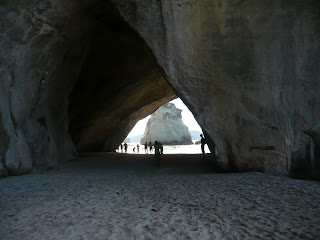
The archway that gives Cathedral Cove its name


Hayden packed up all his gear, launched us out the same as when we’d started – we formed a raft immediately like the seasoned pros that we were – then he took us out to an island off the coast where there was a sea arch that we could paddle through. “Use your paddles to fend off the walls if you need to” said Hayden, but we were so expert by this stage that we steered a faultless passage through. As we lay in the lee of the island, Hayden told us a bit more about the Maori history of the area, including a story about the fate of some warriors captured after a battle and how he dealt with them at Hot Water Beach – about which more later. We then raised a makeshift sail using our paddles and holding our kayaks together in a raft, and sailed some of the way back to our destination beach. This was just as well as our arms and shoulders were beginning to feel the strain a bit by now – the whole round trip takes 3 ½ hours. We beached using the same routine as before, avoiding the big waves crashing in, which had picked up in the mid-afternoon on-shore breeze.

After a quick change in to dry clothes we then headed for home, to shower properly and get ready for the evening’s entertainment: Gauguin’s Shells – The Return.

Apart from mucking up our booking (they’d been expecting us at six, although we’d specifically said 7:30. “For five people again?” “No, for six” (we’d been joined by uncle Bruce) got interpreted as six o’clock. Nevertheless, they took our order, and managed to bring it within an hour – the maitre d’ having again had to resort to offering us some bread and pesto as it was taking so long. The food, when it arrived, was good; I’m just not sure how much call there is for sous-vide cooking in a small town in Coromandel.

The final turn was to be told that they were out of crème brûlée when I ordered it for dessert; only to see them bring plateloads of crème brûlées out to another table, who’d presumably ordered the last of them.

On the way home, the moonless night sky was so clear that we could see the Milky Way shining brightly.